And Why the Problem Isn’t Clinical — It’s Operational
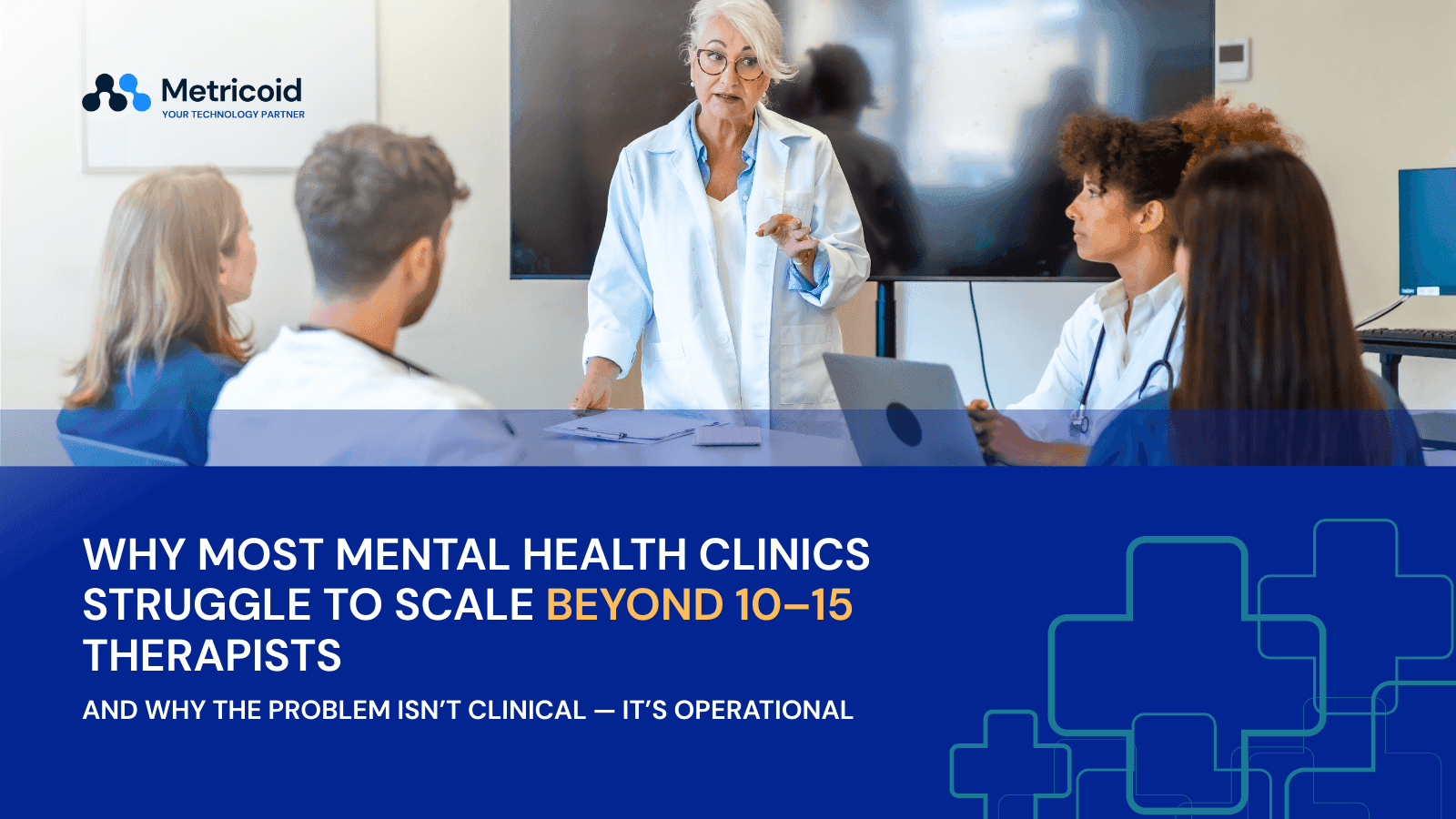
Most mental health clinics in the United States struggle to scale beyond 10–15 therapists not because of care quality, but because of operational breakdowns. Intake bottlenecks, documentation overload, scheduling inefficiencies, billing errors, and lack of operational visibility compound as clinics grow. Generic EHRs and disconnected tools fail to support therapy-specific workflows at scale. Clinics that redesign operations using workflow automation and purpose-built systems are able to grow sustainably, reduce therapist burnout, and improve margins.
Introduction: A Common Scaling Pattern in U.S. Mental Health Clinics
Across the United States, mental health clinics are experiencing unprecedented demand. Awareness is increasing, stigma is reducing, and access through tele-mental health has expanded rapidly.
Yet despite strong demand, many clinics hit a growth ceiling somewhere between 10 and 15 therapists.
At this stage:
➜ Appointments are full
➜ Therapists are clinically strong
➜ Referrals are steady
But internally, things begin to strain.
Founders feel overwhelmed.
Operations teams are constantly firefighting.
Therapists begin to burn out.
This pattern is not accidental.
Mental health clinics rarely stop scaling because of clinical limitations.
They stop scaling because operations were never designed to scale.
Mental Healthcare Demand Is Not the Problem

Nearly one in five adults in the United States experiences a mental illness each year, according to the National Institute of Mental Health. Anxiety, depression, trauma, and stress-related conditions continue to rise, especially in the post-COVID era.
Data from the Centers for Disease Control and Prevention shows a steady increase in reported mental health symptoms across all age groups.
At the same time, tele-mental health adoption has expanded access nationwide. Policy changes and reimbursement support from the Centers for Medicare & Medicaid Services have made remote care a permanent part of the mental healthcare ecosystem.
In simple terms:
➜ Demand exists
➜ Patients are willing
➜ Providers are needed
When growth stalls, the cause is almost always operational, not clinical.
The 10–15 Therapist Scaling Ceiling Explained
When clinics are small, informal systems work.
Intake forms are manageable.
Scheduling is manual but tolerable.
Documentation happens independently.
Once a clinic grows beyond 10–15 therapists, complexity increases exponentially.
More patients.
More therapists.
More documentation.
More billing rules.
The systems that worked at five therapists were never designed for this level of coordination.
1. Intake Bottlenecks Silently Kill Growth
Intake is the front door of a mental health clinic.
In many growing clinics, intake still relies on:
▶ Generic website forms
▶ Manual review by administrative staff
▶ Informal therapist matching
▶ Delayed follow-ups
As patient volume increases, problems appear:
▶ Incomplete intake information
▶ No structured triage by condition or urgency
▶ Delays before first patient contact
▶ Higher patient drop-off rates
According to the Substance Abuse and Mental Health Services Administration , delays in access to mental healthcare significantly increase the likelihood that patients disengage before treatment begins.
Clinics often believe demand is the issue, when in reality intake workflows are the bottleneck.
2. Therapist Burnout Is a Systems Problem
Therapist burnout is often blamed on emotional workload.
In reality, administrative and documentation burden plays a major role.
The American Psychological Association consistently reports that excessive documentation and administrative tasks are among the leading contributors to clinician burnout.
As clinics scale:
▶ Therapists spend more time writing notes
▶ Documentation standards become inconsistent
▶ Supervisors struggle to review quality
▶ Compliance risks quietly increase
Generic documentation tools and rigid templates were not designed for therapy-specific workflows.
Burnout is not a personal failure.
It is a system design failure.
3. Why Generic EHRs Fail Mental Health Clinics at Scale
Most EHR platforms were originally built for general healthcare.
General healthcare workflows are episodic, checklist-driven, and transactional.
Mental healthcare workflows are longitudinal, narrative-driven, and relationship-based.
As clinics grow, generic EHRs introduce:
▶ Rigid workflows
▶ Poor customization
▶ Manual workarounds
▶ Disconnected modules
This is not about bad software.
It is about software designed for the wrong problem.
4. Scheduling Inefficiencies Create Chaos and Revenue Loss
Scheduling complexity multiplies as clinics grow.
Common challenges include:
▶ Rising no-show rates
▶ Poor waitlist utilization
▶ Uneven therapist workloads
▶ Constant manual rescheduling
Research published in Health Affairs links scheduling inefficiencies directly to reduced patient satisfaction and financial performance.
Adding more tools without integrating workflows often increases fragmentation rather than solving the problem.
5. Billing Inefficiencies Create Hidden Revenue Leakage
Revenue leakage is one of the most dangerous operational problems because it often goes unnoticed.
According to the Medical Group Management Association, administrative inefficiencies cost healthcare practices thousands of dollars per provider every year.
As clinics scale:
▶ Documentation mismatches increase claim denials
▶ Manual corrections become routine
▶ Reimbursements are delayed
▶ Margins fail to improve
Many founders report feeling extremely busy without seeing corresponding financial growth. This is almost always a sign of operational inefficiency, not market pressure.
6. Lack of Operational Visibility Limits Growth Decisions
Growing clinics need clarity on:
▶ Therapist utilization
▶ Cost per session
▶ Patient drop-off points
▶ Service profitability
Yet most clinics rely on spreadsheets, exports, or intuition.
Without real-time operational visibility, leadership teams are forced to make reactive decisions instead of strategic ones.
The Core Issue: Clinics Grow Faster Than Their Systems

Most mental health clinics scale by:
➜ Hiring more therapists
➜ Adding administrative staff
➜ Stacking additional tools
But systems do not evolve at the same pace.
This creates:
➜ Operational drag
➜ Burnout
➜ Fragility
Growth without intentional system design eventually collapses under its own weight.
Why Hiring More Staff Does Not Solve the Problem
People can temporarily compensate for broken systems.
However:
➜ Training time increases
➜ Errors multiply
➜ Costs rise faster than revenue
Systems scale.
People stabilize.
Long-term growth requires systems that reduce dependency on manual intervention.
What Scalable Mental Health Clinics Do Differently

Clinics that successfully scale beyond 15–20 therapists typically focus on:
➜ End-to-end workflow design
➜ Automation of repetitive administrative tasks
➜ Therapy-specific documentation processes
➜ Integrated intake, scheduling, billing, and reporting
In these clinics, technology supports care instead of obstructing it.
When Custom Workflow Automation Makes Sense
Custom software is not necessary on day one.
However, it becomes valuable when:
➜ Off-the-shelf tools require constant workarounds
➜ Workflows are unique to the clinic
➜ Growth creates persistent operational friction
This inflection point commonly appears at 10–15 therapists.
Custom does not mean rebuilding everything.
It means designing systems around how the clinic actually operates.
Key Takeaway for Mental Health Leaders
Scaling challenges in mental healthcare are:
➜ Predictable
➜ Operational
➜ Fixable
Mental health clinics do not scale by working harder.
They scale by designing better systems.
Many mental health founders assume their operational challenges are unique until they realize how common these patterns are across growing clinics.
If you are scaling a mental health practice and these challenges feel familiar, it can be helpful to explore how other clinics are redesigning workflows, automation, and systems today.
A Note from Metricoid
At Metricoid, we work closely with mental health clinics and behavioral health organizations in the United States to help them redesign and automate their operational workflows as they scale.
Our work typically focuses on areas such as intake optimization, therapist documentation workflows, scheduling automation, operational dashboards, and secure system design tailored specifically to how mental health clinics actually operate — not how generic tools assume they should.
If you are navigating growth challenges and exploring how other clinics are approaching operational automation today, we are always open to sharing perspectives and lessons learned from working across different clinic models.
No pitches.
Just practical insight.