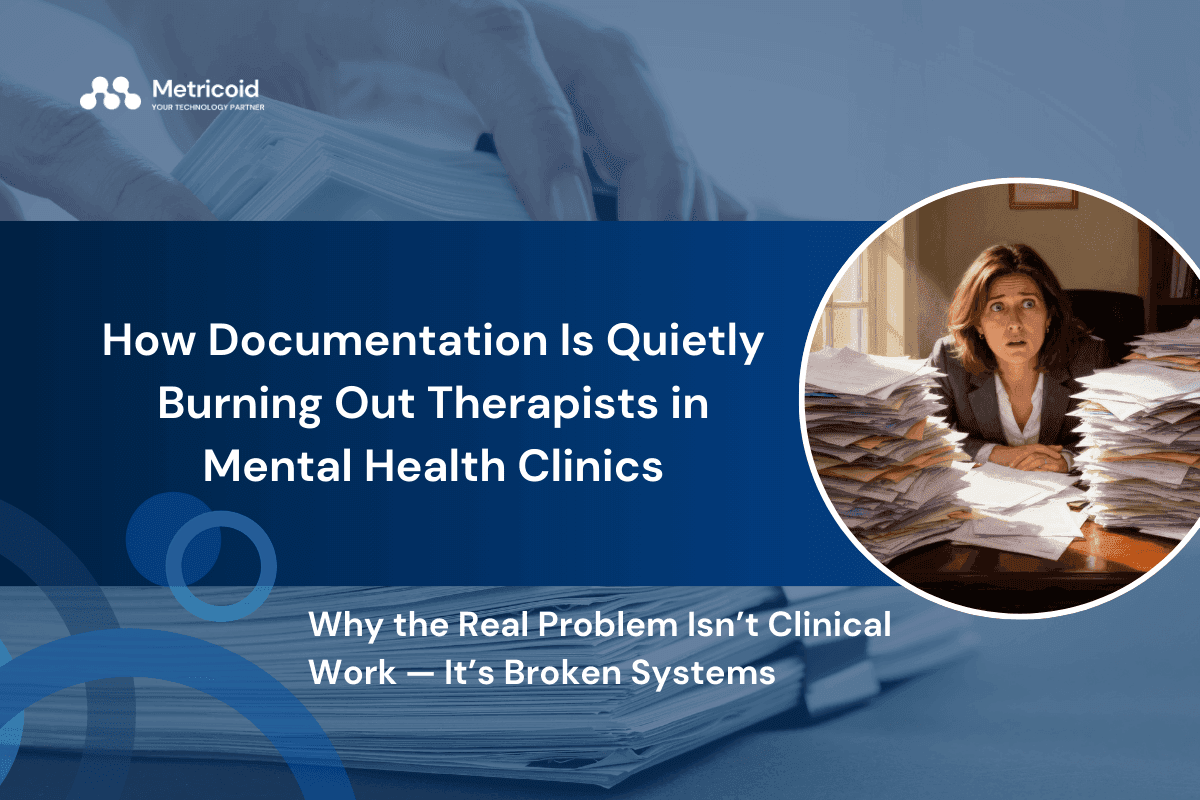
Why the Real Problem Isn’t Clinical Work — It’s Broken Systems
Therapist burnout in U.S. mental health clinics is often blamed on emotional workload and patient complexity. In reality, one of the biggest drivers of burnout is documentation overload. As clinics grow, therapists spend increasing amounts of time writing notes, navigating rigid EHR templates, and fixing administrative gaps. Generic SaaS tools fail to support therapy-specific documentation workflows at scale. Clinics that redesign documentation using custom workflows and human-in-the-loop automation significantly reduce burnout, improve consistency, and create sustainable growth without compromising care quality.
Introduction: The Burnout Problem No One Wants to Talk About
Ask any mental health clinic leader about burnout, and you’ll hear familiar explanations:
“Therapy is emotionally demanding”
“Clinicians are overwhelmed by patient needs”
“The work is heavy”
While all of this is true, it hides a deeper and more actionable truth.
Most therapists are not burning out during sessions.
They are burning out after sessions.
Late evenings spent writing notes.
Weekends catching up on documentation.
Constant pressure to stay compliant while staying present with patients.
Burnout is not coming from care itself.
It is coming from systems that were never designed for how therapy actually works.
The Scale of the Burnout Problem in the U.S.
The American Psychological Association has repeatedly reported that administrative burden is one of the leading contributors to clinician stress and burnout.
Mental health professionals consistently cite:
-
Excessive documentation requirements
-
Poorly designed EHR workflows
-
Time spent on non-clinical tasks
As demand for mental health services rises across the U.S., clinics are hiring more therapists — but without fixing documentation systems, burnout simply scales with headcount.
Documentation Was Meant to Support Care — Not Compete With It

Clinical documentation serves important purposes:
◆ Continuity of care
◆ Legal and compliance requirements
◆ Billing and reimbursement
◆ Clinical reflection
The problem is not documentation itself.
The problem is how documentation is implemented in most clinics.
What Documentation Looks Like in Many Mental Health Clinics

In practice, therapists often deal with:
➜ Long, rigid note templates
➜ Repetitive data entry
➜ Multiple systems for notes, scheduling, and billing
➜ Pressure to document quickly and perfectly
This creates a constant tension:
“Be fully present with the patient — but don’t forget to document everything correctly.”
Over time, this tension becomes exhaustion.
Why Documentation Pain Increases as Clinics Grow
At small scale, documentation problems are tolerated.
At larger scale, they become destructive.
As clinics grow:
More therapists = more variation in documentation styles
➜ Supervisors struggle to review quality consistently
➜ Compliance risk increases
➜ Billing errors become more frequent
Instead of fixing systems, clinics often respond by:
➜ Adding rules
➜ Adding audits
➜ Adding pressure
Burnout accelerates.
The Hidden Cost of Documentation Overload
Documentation overload leads to:
➜ Reduced therapist satisfaction
➜ Increased turnover
➜ Lower care quality
➜ Shorter therapist tenure
➜ Higher recruitment costs
Clinics often underestimate how much documentation pain contributes to attrition — until experienced clinicians leave.
Why Generic EHRs Fail Therapists

Most EHR systems were not designed with therapy-first workflows in mind.
They were designed for:
➜ Episodic care
➜ Structured checklists
➜ High-volume medical visits
Mental healthcare is different.
Therapy is:
➜ Narrative
➜ Longitudinal
➜ Relationship-based
➜ Context-rich
Generic EHRs struggle to support this reality.
Common EHR-Driven Documentation Problems
1. Rigid Templates
Therapists are forced into structures that don’t match their modality or style.
2. Repetitive Data Entry
The same information is entered multiple times across systems.
3. Poor Flow With Sessions
Documentation feels disconnected from the therapeutic process.
4. Billing-Driven Design
Notes are optimized for reimbursement, not for clinicians.
The result: therapists work around the system instead of with it.
Why Adding More SaaS Tools Makes It Worse
Many clinics attempt to solve documentation pain by adding:
➜ AI note-taking tools
➜ Add-on transcription software
➜ Separate documentation apps
This often backfires.
Why SaaS Falls Short:
-
One-size-fits-all note logic
-
Black-box AI behavior
-
Limited customization
-
Poor integration with clinic workflows
Therapists end up managing yet another tool — not less work.
The Fear Around AI in Mental Health Documentation

Clinics are interested in AI — but cautious.
Common concerns include:
◆ Accuracy of notes
◆ Loss of clinical voice
◆ Patient privacy
◆ HIPAA compliance
◆ Over-automation of care
These concerns are valid.
The issue is not AI itself — it’s how AI is applied.
What Actually Works: Human-in-the-Loop Documentation
Successful clinics do not let AI replace therapists.
They let AI assist therapists.
This means:
◆ AI drafts notes
◆ Therapists review, edit, and approve
◆ Final authority stays with humans
This approach:
➜ Saves time
➜ Preserves clinical judgment
➜ Builds trust with clinicians
How Custom Documentation Workflows Reduce Burnout
Custom software allows clinics to redesign documentation around real practice.
- Therapy-Specific Templates
Templates aligned to:
◆ Modality
◆ Clinic standards
◆ Therapist preferences
- Reduced Cognitive Load
Less clicking.
Less repetition.
More flow.
- Integrated Workflows
Notes connect directly with:
◆ Scheduling
◆ Billing
◆ Reporting
- Optional AI Assistance
AI supports speed — not decision-making.
The Compounding Benefits of Better Documentation
When documentation improves:
◆ Therapists finish work on time
◆ Burnout decreases
◆ Retention improves
◆ Compliance becomes easier
◆ Billing accuracy improves
Documentation is not just an admin task.
It is a strategic lever.
A Note from Metricoid
At Metricoid, we work with mental health clinics across the United States to redesign documentation workflows that support therapists instead of exhausting them.
Our approach focuses on:
➜ Aligning documentation with real clinical practice
➜ Reducing unnecessary admin steps
➜ Introducing AI carefully, with full clinician control
➜ Integrating documentation into the broader operational system
The goal is not faster notes at any cost —
it is sustainable care delivery.
Key Takeaway for Clinic Leaders
Therapist burnout is not inevitable.
When documentation systems are poorly designed, burnout rises.
When systems are redesigned thoughtfully, burnout falls.
Fixing documentation is not about compliance.
It is about protecting clinicians and the care they provide.
If your therapists are staying late, working weekends, or expressing frustration with documentation, the problem may not be workload — it may be workflow.
Documentation systems should support therapy, not compete with it.
For many clinics, rethinking documentation is the first step toward healthier teams and sustainable growth.